

Chinese Lessons - Part I: The darkest part of China's night, before the dawn of prosperity
Would a government kill 55 million of its own people? - Eugenics update on China


At a time when the European economies are in the doldrums, Germany is in its third year of recession – for the first time since the recession that helped bring Adolf Hitler to power in 1933 – and China is challenging the US for global economic leadership (while when many observers are saying China has already won the contest, by having decisively moved ahead of the US) we must not lose sight of some fundamental truths, namely that Western economies can also enjoy sustainable, high and equitable economic growth, even at a brisk pace of double-digit growth rates, without inflation and without banking crises.
Given the facts of the credit creation process and the powers of central bankers, we know that whenever we see a country in recession, this is a policy-decision by the central planners, because the tools are available to quickly exit any recession and deliver high growth and prosperity for all.
Realisation of this fact might turn some observers pessimistic. But I think instead of adopting a negative and nihilistic attitude, such as “Europe is finished”, or “America is lagging behind”, or “the system has run its course and is collapsing”, we have to understand – and spread the knowledge – that economic doldrums are not a law of nature. Recessions are not inevitable. They are the result of conscious policy decisions.
I want to refocus attention onto the ingredients of success, and ensure that an increasing number of people know them, and demand such successful policies from their own lawmakers. We simply should not accept a recession or low economic growth. Neither should we welcome asset bubbles, and the mayhem that follows them. These are all avoidable problems, which can be ended in short time at any moment.
The world is abundant and we can all live in abundance. Decision-makers delivering failure after failure, causing wars, unemployment and crises – while simultaneously using these crises to sell their favourite new policies to increase their powers and controls over us as the feigned solution – must be held to account everywhere. It’s not left vs. right, Republicans vs. Democrats, Conservative vs. Labour. It’s power-hungry central planners who want to control us vs. the People, as Lord Acton recognised long ago (the same Lord Acton who observed correctly that power corrupts and absolute power corrupts absolutely – he thus was a staunch opponent of powerful central planners).
In my view a good way to tackle this topic is to review just how China achieved its remarkable rise from developing country status to a developed industrialised economy in only four brief decades so that it is in many sectors becoming the leading nation in the world. However, that has to wait for Part II, to be released shortly. For before we can let the bright lights of high growth and prosperity shine upon us, unfortunately I first have to take the reader to one of the darkest episodes in the twentieth century, indeed in recorded human history.
China’s surge to superpower status in only 40 years can teach us much
The changes that commenced China’s rise to prosperity and economic strength were brought about by someone called Deng Xiaoping (邓小平, or in older script, 鄧小平), who rose to power in 1978, not long after strongman Chairman Mao had died. (A note concerning Chinese names: I am here following the common practice of making an exception for Chinese names by adopting the East Asian language naming order, even when writing in Western languages, by naming the family name first, as East Asian languages do, such as Chinese, Japanese, Korean, Vietnamese or Hungarian; since this text is in English, we should really follow the English naming order, but we would be the only ones doing this, and it might cause confusion if we said ‘Xiaoping Deng’ or ‘Zedong Mao’).
To understand where Mr Deng came from and where China stood at the time he came to power, we need to first reflect on what had happened in the three decades before 1978.
This is also highly instructive for other reasons, and hence merits its own report (this Part I): I have often said that in order to understand the current, and imminent, policies of the European Union, and what is happening in the UK and even the USA, one needs to study the Stalinist Soviet Union and Maoist China. Many policies and psyops will be eerily familiar. This is what this Part I is about. We can then turn to the actual ingredients of success, the Elixir of High Growth, in Part II, which is to follow shortly.
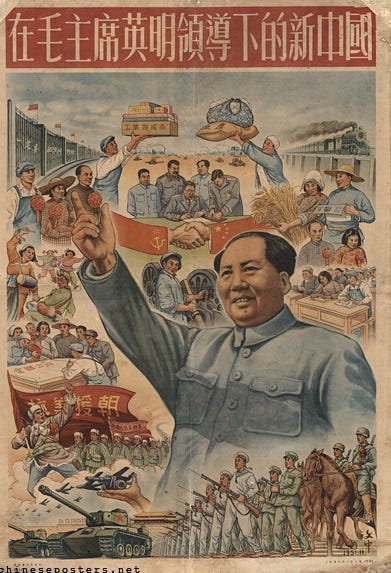
Before 1978: Central planners set out to centralise and reduce the population
Keep reading with a 7-day free trial
Subscribe to Richard Werner’s Substack to keep reading this post and get 7 days of free access to the full post archives.